 blog
7 Safe Exercises for Seniors With Cognitive Impairment
Last Updated: October 31, 2026
Quick Summary
Safe physical exercises for seniors cognitive impairment combine seated chair work, short familiar walks, and strength, balance, and flexibility training matched to current ability. Aim for about 150 minutes of moderate activity per week, broken into short sessions, with clinician clearance and arm's-length supervision for standing work.
- Seated marching, arm raises, band pulls, ankle circles, and torso twists form a simple chair routine.
- Move to the next progression stage only after two comfortable weeks at the current stage.
- Short movement breaks of 5-10 minutes, two to three times daily, suit low stamina or restlessness.
- Use one-step cues like lift your right knee, and demonstrate before guiding with a light touch.
- Stop and call a clinician for chest pain, fainting, sudden one-sided weakness, or slurred speech.
Table of Contents
- Why Movement Matters for Seniors With Cognitive Impairment
- Chair Exercises for Seniors With Dementia
- Walking Activities for Seniors With Dementia
- Strength, Balance, and Flexibility Work That Fits the Ability
- How Long Should Seniors With Dementia Exercise?
- Safe Exercise Tips for Seniors With Dementia and Their Caregivers
- Building a Weekly Routine at Emory Mills
- Frequently Asked Questions
Why Movement Matters for Seniors With Cognitive Impairment
A 2025 review found that moderate-intensity aerobic exercise and moderate-to-high-intensity resistance training are safe and effective for improving cognitive outcomes in older adults, according to research published in PubMed Central.
At Emory Mills, we build movement into daily life because it can support focus, mood, and confidence. The goal is never a hard workout.
Movement helps in several ways:
- It supports blood flow and oxygen flow to the brain.
- It builds physical strength and mobility for daily tasks.
- It lowers fall risk by improving balance and coordination.
The key is matching the exercise to the person, not the other way around.
Chair Exercises for Seniors With Dementia
Chair exercises for seniors with dementia are seated movements done from a sturdy chair with back support. A 2008 review describes dementia exercise programs that include gentle stretching, strength training, balance, and endurance activities, detailed in the PubMed Central review.
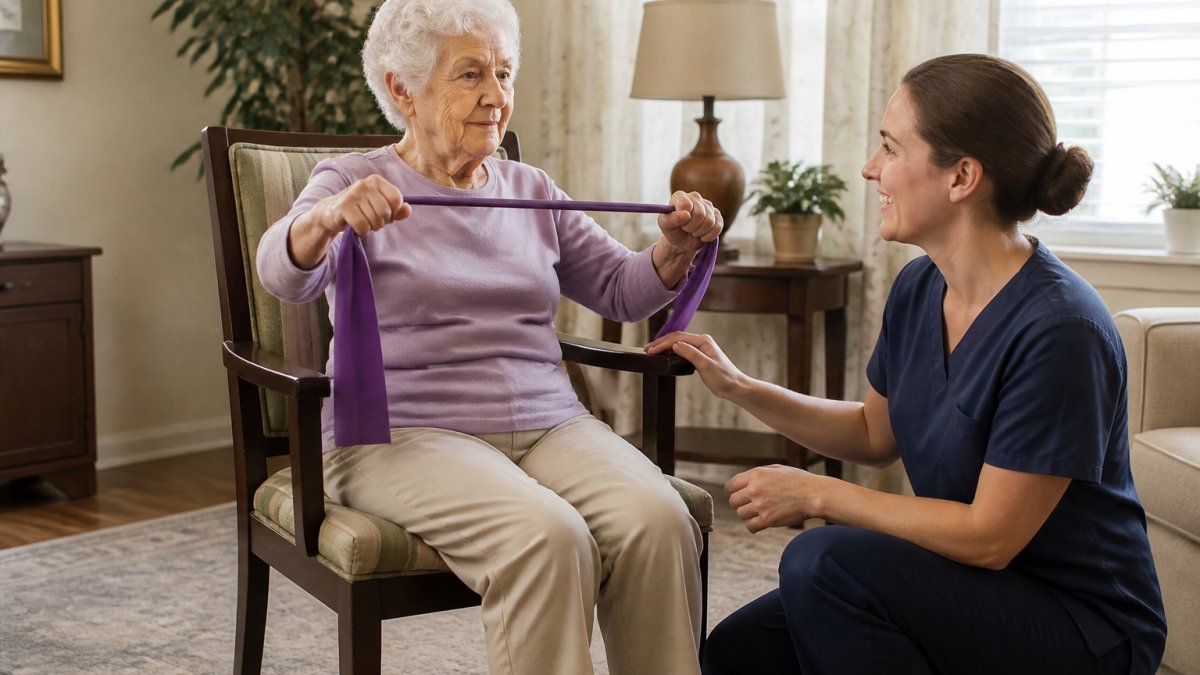
Here is a simple seated routine:
- Seated marching. Lift each knee in turn for 30 seconds.
- Arm raises. Raise both arms overhead and lower slowly, 10 times.
- Band pulls. Hold a light band and pull outward, 10 times.
- Ankle circles. Rotate each ankle 10 times per direction.
- Seated torso twists. Turn gently side to side, 10 times.
Keep the chair against a wall so it cannot slide. For readers who want to extend seated activity into engagement, our guide on adapting board games for memory loss offers ideas that pair well with a chair routine.
Walking Activities for Seniors With Dementia
Walking activities for seniors with dementia work best when they are short, familiar, and predictable. A 2025 Johns Hopkins report suggests that adding as little as five minutes of daily physical activity may reduce dementia risk in older adults, noted in Johns Hopkins Bloomberg School of Public Health.
Try these walking options:
- A loop around the block at the same time each day.
- A nature walk on a flat, paved path.
- Indoor hallway laps during bad weather.
Watch out: a person who wanders can slip away during an outdoor walk. Stay within arm's reach, use a buddy system, and choose enclosed routes when possible.
Strength, Balance, and Flexibility Work That Fits the Ability
Strength, balance, and flexibility work should match the person's current ability, not a target from a fitness chart. The CDC says adults age 65 and older need aerobic, muscle-strengthening, and balance activities each week, and recommends at least 150 minutes of moderate-intensity aerobic activity, per CDC older adult activity guidance. A 2024 review recommends multi-component and aerobic training, with 2 to 3 sessions per week of about 60 minutes each, according to Z. Li et al. in ScienceDirect.
What the guidelines do not tell you is how to progress a person whose abilities change week to week. Use the three-stage progression below, and move to the next stage only when the person completes the current stage comfortably for two weeks.
Stage 1: Seated and fully supported
Best for limited mobility, high fall risk, or early sessions.
- Strength: seated sit-to-stands from a firm chair with armrests, 5-8 reps; seated band rows, 8-10 reps; seated heel raises, 10 reps.
- Balance: seated weight shifts side to side and forward and back, 30 seconds each; seated marching, 30 seconds.
- Flexibility: seated neck turns, shoulder rolls, and ankle circles, 8-10 per direction; seated hamstring stretch with one leg extended, hold 20-30 seconds.
Stage 2: Supported standing
Best for people who can stand with a hand on a counter or walker.
- Strength: counter-supported sit-to-stands, 8-10 reps; standing band pulls, 8-10 reps; standing heel raises holding the counter, 10 reps.
- Balance: heel-to-toe standing near a counter, 20-30 seconds; single-leg holds with fingertip support, 10 seconds per side; side-stepping along the counter, 10 steps each way.
- Flexibility: standing calf stretch at the counter, 20-30 seconds per side; standing quad stretch with support, 20-30 seconds per side.
Stage 3: Independent with supervision
Best for people who walk without hands-on help and follow two-step instructions.
- Strength: body-weight squats to a chair, 8-12 reps; light dumbbell or band exercises for arms and shoulders, 8-12 reps; step-ups to a low step with rail support, 5-8 per side.
- Balance: tandem stance, 20-30 seconds; single-leg stand, 10-15 seconds per side; slow walking with head turns, 10 steps.
- Flexibility: full standing stretch routine, holding each stretch 20-30 seconds.
Adapt for common conditions
- Arthritis: favor seated and water-based work, avoid deep knee bends, and stretch before strengthening.
- Heart conditions: keep intensity at a level where the person can talk in short sentences, and follow any clinician-set limits on heart rate or exertion.
- Balance problems or neuropathy: prioritize Stage 1 and 2 balance work and keep a hand on the person during standing exercises.
- Fatigue: shorten sessions to 5-10 minutes, twice daily, rather than one long session.
Someone who uses a walker can do balance work while holding a counter. Someone with limited mobility can do strength work seated. The progression, not the calendar, sets the pace.
How Long Should Seniors With Dementia Exercise?
Seniors with dementia should aim for about 150 minutes of moderate activity per week, spread across most days, with shorter sessions when stamina is low. A 2019 article recommends that older adults with mild cognitive impairment or subjective cognitive decline do moderate-intensity aerobic physical activity for at least 150 minutes per week, as outlined in N. T. Lautenschlager et al..
That total can be broken into small blocks. Use this guide:
| Session Goal | Duration | Frequency | Best For |
|---|---|---|---|
| Short movement break | 5-10 minutes | 2-3 times daily | Low stamina or restlessness |
| Standard session | 20-30 minutes | Most days | Building a routine |
| Full session | 45-60 minutes | 2-3 times weekly | Higher ability levels |
Rest is part of the plan. Watch for overuse injuries, and stop if the person shows pain, dizziness, or unusual fatigue.
Safe Exercise Tips for Seniors With Dementia and Their Caregivers
Safe exercise for seniors cognitive impairment starts before the first repetition. The screening and supervision steps below are the ones most often skipped, and they are the ones that prevent injury. Establishing this physical foundation creates a stable environment where incorporating cognitive exercises for seniors can further support overall brain health and functional independence.
Screen before you start
Get clinician clearance before beginning or changing a routine, especially if the person has a heart condition, uncontrolled blood pressure, diabetes, a recent fall, osteoporosis, or a new medication. Bring a short list to the appointment: current diagnoses, all medications and supplements, recent falls, and any pain the person can describe. Ask specifically whether any medication affects balance, blood pressure during exertion, or alertness, common culprits include blood pressure drugs, sedatives, antidepressants, and blood thinners.
Recognize the warning signs during activity
Watch for changes from the person's baseline rather than a fixed list. Common stop signals include new grimacing or guarding, unusual confusion or agitation, repeated loss of balance, pale or flushed skin, and unusual fatigue that does not resolve with a short rest. Because a person with dementia may not report pain accurately, look for behavior changes, refusing to continue, rubbing a joint, or becoming suddenly withdrawn, as possible pain signals.
Caregiver cueing and communication
How an instruction is given can matter as much as the exercise itself. Use these strategies:
- One step at a time. Say "lift your right knee," not "do ten marches."
- Demonstrate, then guide. Show the movement, then use a light touch on the shoulder or hand to cue direction.
- Name the body part. "Push the floor away with your feet" is clearer than "stand up."
- Count out loud to set a rhythm and signal when to stop.
Set up the space and the person
- Clear the floor of rugs, cords, and clutter; keep a clear path to the bathroom.
- Use a sturdy chair with armrests, placed against a wall so it cannot slide.
- Have a counter or handrail within reach for any standing work.
- Choose supportive, non-slip shoes with a low, wide heel, not slippers or socks.
Fall prevention and environmental setup matter as much as the exercise itself. Sturdy shoes make a real difference, and our article on the best footwear for preventing falls in seniors explains what to look for. For caregivers setting up a safe space at home, our guide on installing grab bars for dementia patients covers the practical steps.
Building a Weekly Routine at Emory Mills
A weekly routine works best when it mixes aerobic, strength, balance, and flexibility work, with rest days built in. A sample week might look like this:
- Monday: 20-minute walk plus seated strength work.
- Tuesday: chair exercises and stretching.
- Wednesday: balance work near a counter.
- Thursday: 20-minute walk plus band pulls.
- Friday: gentle yoga or tai chi.
- Saturday: short nature walk.
- Sunday: rest and light stretching.
At Emory Mills, movement is part of a larger day that includes chef-prepared meals, social activity, and 24/7 support. Our I'm Still Here® philosophy centers each resident's life story and remaining abilities. That means exercise is matched to the person, not a generic schedule. If you are planning an ongoing activity routine, our ideas for senior living social activities that build real connection can help round out the week. You can also find answers about services and tours on our frequently asked questions page.
Frequently Asked Questions
What exercises are safe for seniors with cognitive impairment?
Research points to a mix of aerobic, strength, balance, and flexibility work rather than one single activity. Published reviews often recommend a mix of aerobic and strength training across the week. Practical options include chair exercises, supervised walking, light resistance band work, and gentle stretching. The CDC notes adults 65 and older need aerobic, muscle-strengthening, and balance activity each week. Check with a clinician before starting, especially with a dementia diagnosis or recent hospital stay.
How much physical activity should an older adult with dementia get?
Published guidance for older adults with mild cognitive impairment often includes moderate aerobic activity across the week. Check current public-health guidance for specific targets. Split it into shorter blocks, such as 20 to 30 minutes on most days, since fatigue and attention span vary. A 2025 Johns Hopkins report suggests even five extra minutes a day may be linked to lower dementia risk, so small amounts still count.
How can caregivers encourage a senior with dementia to exercise?
Keep sessions short, familiar, and tied to a routine the person already knows, such as a walk after breakfast. Demonstrate the movement instead of explaining it, use one instruction at a time, and offer praise as you go. Pair exercise with something enjoyable, like music or a favorite outdoor route. Exercise programs for people with dementia often include gentle stretching, strength, balance, and endurance activities, which can be broken into small pieces. Stop if the person seems distressed and try again later.
When should someone with cognitive impairment stop exercising?
Stop and contact a clinician if the person reports chest pain, dizziness, shortness of breath, or unusual weakness, or if balance suddenly worsens. There is no single intensity threshold that fits every older adult with cognitive impairment, so a clinician who knows the person's health history should guide the starting point. That is why a clinician who knows the person's medications, heart health, and fall history should set the starting point. Safe exercise for seniors with cognitive impairment always begins with that screening conversation.
Building a safe movement routine takes patience, planning, and the right support. At Emory Mills, we pair personalized daily support with meaningful engagement, chef-prepared meals, and round-the-clock care so residents can stay active at their own pace. Get started with Emory Mills and schedule a tour to see how a movement-friendly day fits your family's needs.