 blog
7 Simple Gardening Activities for Seniors With Dementia
Last Updated: October 29, 2026
Quick Summary
Simple gardening activities for seniors with dementia work because they ask for motion and attention without demanding memory. A 2026 review reported that gardening interventions consistently improved mood and well-being and reduced behavioral symptoms, while evidence for cognitive gains was mixed. Each activity uses large movements, needs little instruction, and produces a visible result.
- Potting one herb in a hand-sized pot takes 10 to 15 minutes and suits early to middle stage.
- Skip the trowel and use a scoop or cup, which is easier to grip and less likely to spill.
- Watering with a small can and a funnel takes 5 to 10 minutes and suits any stage.
- Work at a table or raised bed so no one bends or kneels, and keep paths clear.
- In later stages, the goal is sensory contact, not completion, so skip the tools entirely.
Table of Contents
- Why Gardening Fits the Abilities of People Living With Dementia
- 7 Simple Gardening Activities for Seniors With Dementia
- Indoor Gardening Activities for Seniors Who Stay Inside
- Sensory Garden Activities for Dementia That Need No Green Thumb
- Easy Plants for Seniors to Grow Indoors
- Safe Gardening for People With Dementia: Setup, Tools, and Supervision
- Matching the Activity to the Stage and to What the Day Allows
- Building a Gardening Routine Into Memory Care at Emory Mills
- Frequently Asked Questions
Why Gardening Fits the Abilities of People Living With Dementia
Simple gardening activities for seniors with dementia work because they ask for motion and attention without demanding memory.
The activity fits what remains, not what has been lost. To see the philosophy behind this ability-focused approach, read how the I'm Still Here® approach makes a difference in memory care transitions.
What the Research Says About Mood, Movement, and Memory
The evidence splits into two clear parts, and it is worth knowing which is which. A systematic review of therapeutic gardens for people with dementia examined quantitative studies on garden visits and gardening therapy. A 2026 review reported that gardening interventions consistently improved mood and well-being and reduced behavioral symptoms, while evidence for cognitive gains was mixed.
The University of Florida IFAS Extension guidance on gardening and Alzheimer's disease makes a related point: simple tasks like harvesting vegetables can encourage interaction, support well-being, and create meaningful moments. No special equipment required.
7 Simple Gardening Activities for Seniors With Dementia
Each activity below uses large movements, needs little instruction, and produces a visible result. Hand over the materials and start alongside them, demonstration beats explanation.
1. Potting a Single Herb in a Hand-Sized Pot
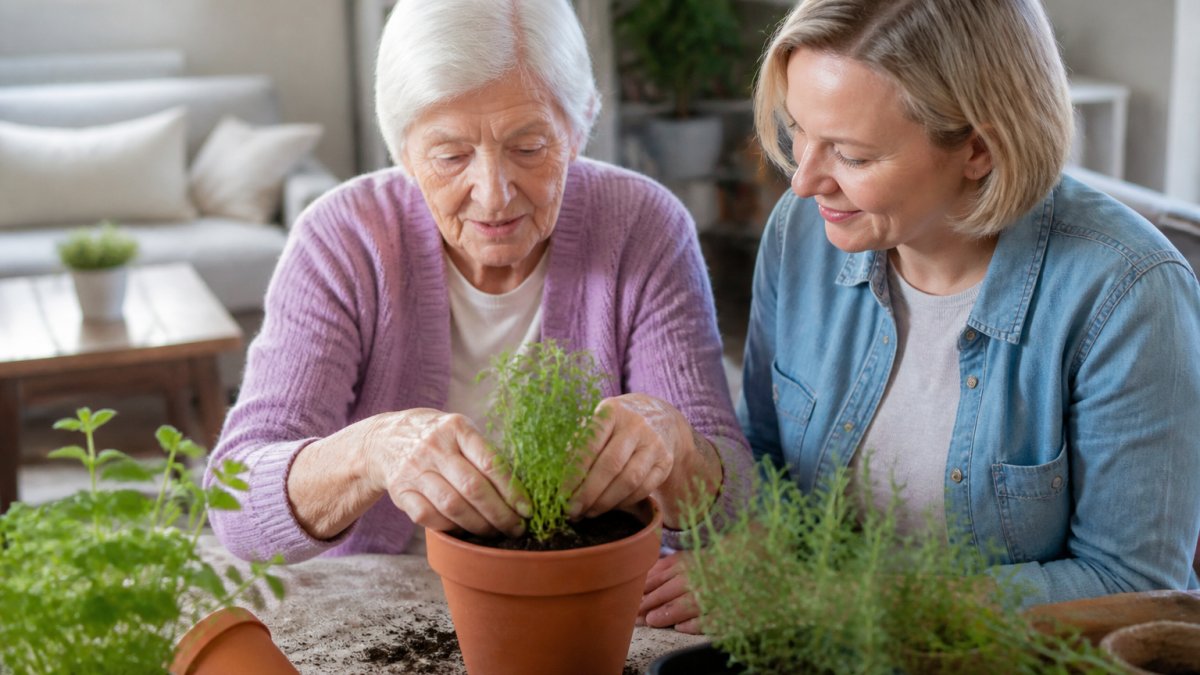
Use one small pot, one herb, and a scoop of potting soil. Basil, mint, or rosemary all work.
Set the pot in front of the person and scoop soil together.
Watch out: skip the trowel. A scoop or a cup is easier to grip and less likely to spill.
2. Sowing Large Seeds in a Raised Bed
Sunflower, nasturtium, bean, and pea seeds are large enough to pick up between two fingers.
3. Watering With a Small Can and a Funnel
Watering is the most repeatable task here, and repetition makes a routine stick. Use a small can, not a full one, so the weight stays manageable.
A funnel takes the guesswork out of aiming. Set it in the pot and pour through it.
This one also builds hand-eye coordination without feeling like exercise.
4. Raking Leaves and Gathering Clippings
Raking is gentle movement with a clear purpose, and the pile proves the work.
Gathering clippings into a bucket adds a second step: find, pick up, drop in. Many enjoy this more than the raking.
Do this on a mild day and keep sessions short.
5. Arranging Cut Flowers in a Vase
No soil, no tools, no mess. Set out a vase and a few stems and let the person decide where each one goes.
6. Wiping Leaves and Checking Plants
A damp cloth and a large-leaf plant like a philodendron or rubber plant give a person something concrete to do: wipe the leaf, look for yellow spots, move to the next.
7. Sorting Seeds and Packets by Color
Empty seed packets, or printed color cards, can be sorted into piles. Red here, yellow there.
| Activity | Time | Best For | Setup Needed |
|---|---|---|---|
| Potting a herb | 10-15 min | Early to middle stage | Pot, soil, herb, scoop |
| Sowing large seeds | 15-20 min | Middle stage | Raised bed, large seeds |
| Watering with a funnel | 5-10 min | Any stage | Small can, funnel |
| Raking leaves | 15-20 min | Early stage, mobile | Light rake, bucket |
| Arranging flowers | 10-15 min | Any stage | Vase, cut stems |
| Wiping leaves | 10 min | Any stage | Cloth, large-leaf plant |
| Sorting seed packets | 10-15 min | Later stage | Packets or color cards |
Indoor Gardening Activities for Seniors Who Stay Inside
For more ideas on keeping residents engaged and connected, our team put together 9 senior living social activities that build real connection.
Sensory Garden Activities for Dementia That Need No Green Thumb
Sensory garden activities for dementia skip planting and go straight to touch, smell, and sound. They suit every stage, including people who can no longer follow multi-step directions.
- Smell: crush a mint or lavender leaf between fingers and pass it around
- Touch: compare a fuzzy lamb's ear leaf with a smooth succulent
- Sound: shake a dried seed pod or rustle ornamental grass
No garden bed required. A single pot on a table covers all five.
Easy Plants for Seniors to Grow Indoors
Easy plants for seniors to grow indoors share three traits: they tolerate missed watering, need no direct sun, and show change the person can see.
- Snake plant: nearly unkillable, upright leaves
- Pothos: trails visibly, forgiving of neglect
- Spider plant: sends out babies, which is a built-in conversation piece
Skip anything fragile, spiny, or toxic if the person might put leaves near their mouth. Check plant toxicity before bringing one into a home where someone may taste-test.
Safe Gardening for People With Dementia: Setup, Tools, and Supervision
General senior-gardening safety covers bending and sharp tools. Dementia adds hazards most guides skip: tasting soil, eating unknown leaves, wandering off mid-task, and forgetting to drink. Use this checklist before the first session and whenever the routine changes.
Setup Checklist
- Work at a table or raised bed so no one bends or kneels.
- Keep paths clear and put a mat under the work area to catch spills.
- Set up in a shaded or indoor spot during peak sun hours.
Tool and Material Safety
- Choose wide grips, light weights, and rounded edges. Replace any tool with a sharp point.
- Skip power tools, ladders, and heavy bags of soil. Scoop soil into smaller containers ahead of time.
- Use potting mix, not garden soil, indoors. Bagged potting mix is formulated for containers and is less likely to carry outdoor contaminants.
Plant Toxicity
Some common garden and houseplants are toxic if chewed or swallowed. Before bringing a plant into a home where someone may taste-test, check it against a reliable list such as the ASPCA Toxic and Non-Toxic Plants database or your state extension service. Common culprits include oleander, foxglove, lily of the valley, and some philodendrons.
Soil and Mouthing
Never leave a person alone with potting soil near their mouth. If mouthing is a pattern, switch to a tray of large seeds or a sensory bowl of clean, moist soil and supervise hand-to-mouth contact closely. Wash hands together after every session.
Hydration and Sun
Offer water at the start and halfway through, not only at the end. People with dementia often do not feel thirst or recognize it. Keep sessions short in heat, use a hat and shade, and watch for confusion that worsens outdoors, an early sign of overheating.
Wandering
A garden task can become a reason to walk away. Work in an enclosed yard or indoors, keep the person in view, and tell a neighbor or household member when a session is starting. If wandering is a known risk, choose tabletop activities instead of outdoor ones.
Supervision Levels
- Within arm's reach: anything involving water, steps, outdoor walking, or soil.
- In the same room: tabletop tasks with no small parts.
- Line of sight: independent sensory contact with a single safe object.
When in doubt, move up one level of supervision. The cost of watching closer is low; the cost of missing a hazard is not.
Matching the Activity to the Stage and to What the Day Allows
Most gardening lists for older adults offer one set of ideas and leave the caregiver to sort out who can do what. Dementia changes that calculation. The right activity depends on four abilities that decline on different timelines: attention span, mobility, dexterity, and communication.
Read the Four Abilities Before You Choose
- Attention: Can the person stay with a task for two minutes, five minutes, or fifteen? If attention is under two minutes, choose a one-step task with an immediate result, like dropping a seed into a hole or wiping one leaf.
- Mobility: Can they stand at a raised bed, sit at a table, or only reach from a chair? Tabletop tasks cover the widest range.
- Dexterity: Can they pinch a large seed, grip a scoop, or only rest a hand on soil? Large seeds and wide-handled scoops work when pinching is hard.
Early Stage: Keep the Sequence, Shrink the Scale
In early stages, people can often still plan and sequence. Offer multi-step projects with a visible beginning and end: planting a container of three herbs, raking a small section, or deciding where pots go on a porch. Keep steps to three or four and say them once, in order.
Middle Stage: One Step, One Result
In middle stages, shift to single-step tasks with a clear finish: watering one pot, wiping three leaves, sorting packets into two piles. Give one instruction at a time and wait: "Put the seed here." Pause. "Cover it." Pause. "Press." If the person starts a different action, follow it briefly before redirecting, arguing costs more than it gains.
Later Stage: Sensory Contact Is the Activity
In later stages, the goal is contact, not completion. A leaf to smell, a flower to hold, soil to touch through fingers, or a seed pod to shake can fill a session. Skip the tools entirely. Sit beside the person, offer the object, and describe what you notice: "This one is fuzzy." Let them respond or not.
Adjust by the Hour, Not Just the Stage
For a closer look at how abilities shift, read our guide to middle stage dementia and how to support it. If late-day agitation is part of your routine, our step-by-step guide to managing sundowning symptoms covers timing strategies.
Building a Gardening Routine Into Memory Care at Emory Mills
Emory Mills is a family-owned senior living community, and its memory care uses the I'm Still Here® philosophy to focus on residents' life stories and remaining abilities. Readers can explore evidence-based memory care at Emory Mills to see how engagement activities like gardening fit into daily practice.
Frequently Asked Questions
What gardening activities are suitable for seniors with dementia?
The best gardening activities for seniors with dementia are short, single-step tasks that use large materials: potting one herb, sowing big seeds like beans or sunflowers, watering with a small can, gathering leaves, or arranging cut flowers. Each takes 10 to 20 minutes and ends with something visible the person can see or hold. A 2026 review reports that gardening consistently improved mood and psychosocial well-being and reduced behavioral symptoms, though evidence for cognitive gains was mixed, so aim for enjoyment rather than memory training.
How can I make gardening safer for someone with dementia?
Safe gardening for people with dementia starts with the setup. Remove thorny plants, poisonous varieties, and anything sharp from reach, use lightweight tools with thick handles, and keep paths flat and clear. Stay within arm's reach during tasks involving water, tools, or standing, and skip power equipment entirely. Check the work area for tripping hazards before you begin, and stop when the person shows signs of fatigue or frustration rather than pushing through to finish a project.
What are easy plants for seniors to grow indoors?
Easy plants for seniors to grow indoors include pothos, snake plants, spider plants, aloe, and herbs like basil, mint, and rosemary. These tolerate missed watering and low light, and several offer scent or texture for sensory engagement. Choose a pot the person can lift with one hand, set it near a window, and put a saucer underneath to catch spills. Mint and basil also give the person something to smell, touch, and eventually use in a meal.
How long should a gardening activity last for someone with dementia?
Plan for 10 to 20 minutes per activity and let the person's attention guide you rather than a clock. Many people with dementia do best with one task, a clear start, and a natural finish, such as a watered pot or a filled vase. If interest fades, stop and return another day. Short, repeated sessions are more valuable than one long project, and they give the person a predictable routine they can recognize week to week.
Gardening will not reverse dementia, and we will not pretend it will. What it can do is give someone a morning with purpose, a reason to use their hands, and a plant that needs them. That is worth planning for.
Emory Mills offers personalized daily support, meaningful engagement built around each resident's abilities, chef-prepared meals, and 24/7 care in a community designed for dignity and belonging. Get started with Emory Mills and schedule a tour to see what a typical day looks like.