 How-to
How Do You Improve Lighting for Dementia Safety?
Quick Summary
Improve dementia safety lighting by making light even and consistent throughout the home, removing glare and harsh shadows, and adding motion-activated nightlights along night routes. Start with the rooms the person uses most, such as the bedroom, bathroom, and kitchen.
- Light hallways, stairs, and entries with steady overhead or wall lighting.
- Use frosted or diffused shades on bare bulbs to reduce glare.
- Keep daytime bedroom bulbs at 3000K-4000K and evening bulbs at 2200K-2700K.
- Place low nightlights along the route to the bathroom, using motion sensors where possible.
- Aim for about 100 lux or more at floor level along walking paths.
Table of Contents
- Why Lighting Matters for Dementia Safety
- The Science of Light, Sleep and Circadian Rhythm
- Step 1: Build Even, Consistent Lighting Throughout the Home
- Step 2: Reduce Glare, Reflections and Harsh Shadows
- Step 3: Set Up Dementia-Friendly Bedroom Lighting
- Step 4: Plan Night Lighting for Safe Movement
- Room-by-Room Lighting Checklist and Home Safety Review
- Scheduling a Home Safety Review With Emory Mills
- Frequently Asked Questions
Why Lighting Matters for Dementia Safety
Last Updated: November 19, 2026
Poor lighting is one of the most overlooked safety risks for people living with dementia. For a person-centered perspective on dementia care beyond the home environment, read I'm Still Here Philosophy: A Practical Guide.
Lighting changes how the brain reads space. A dark patch can look like a hole in the floor, and a bright reflection can look like water.
Below, we walk through the steps, a room-by-room checklist, and a few practical ideas you can start on this week. Because lighting changes can make familiar rooms safer while supporting daily routines, Personal Care Home Health can also be part of planning care that continues through the night.
The Science of Light, Sleep and Circadian Rhythm
The body keeps a daily clock, called the circadian rhythm, and light is the main signal that sets it.
Many people with dementia have trouble with this rhythm. They may nap through the day, wake at night, or become restless in the late afternoon.
The same review also noted a catch. Glare and discomfort can make bright light hard to keep up.
Step 1: Build Even, Consistent Lighting Throughout the Home
Even light is the foundation of dementia-friendly lighting. The goal is to remove dark spots and bright spots so the whole space looks the same from one step to the next.
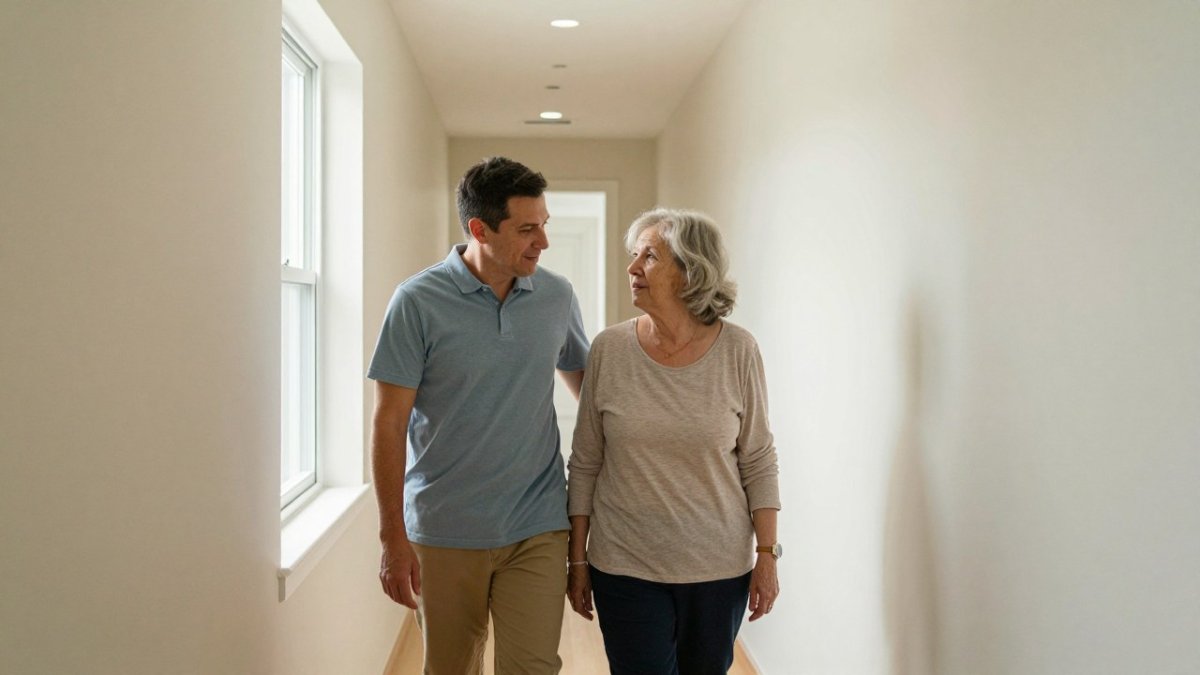
- Light hallways, stairs, and entries with steady overhead or wall lighting
- Avoid a single bright lamp that leaves the rest of the room dark
- Keep bulb color and brightness consistent from room to room
The NHS advises making lighting bright, even, and natural where possible. NHS guidance on making a home dementia friendly Start with the rooms the person uses most, such as the bedroom, bathroom, and kitchen.
Step 2: Reduce Glare, Reflections and Harsh Shadows
Glare and shadows can make a floor look uneven or a doorway look blocked. Reflections on tile, glass, or polished floors can be just as confusing.
- Use frosted or diffused shades on bare bulbs
- Move lamps so light does not shine straight into the eyes
- Choose matte floor finishes where you can
Test each change by walking the route at the time of day the person is most active. What looks fine from a seated position can still cast a shadow across a walkway.
Step 3: Set Up Dementia-Friendly Bedroom Lighting
The bedroom is where lighting has to do two opposite jobs: support alertness and dressing in the morning, then fade into something calm enough that a person with dementia can fall back asleep after a 2 a.m. bathroom trip. The specifics below can help make lighting work well in a bedroom.
Choose bulbs by color temperature and rendering, not just wattage
Color temperature is measured in kelvin (K). General lighting guidance often suggests the following ranges:
- Daytime task light: 3000K-4000K. This is neutral-to-cool white. It reads as "morning" to the brain and supports dressing, medication sorting, and reading.
- Evening and night: 2200K-2700K. Warm white or amber. It is less likely to suppress melatonin and is easier on eyes that are already glare-sensitive.
- Color rendering (CRI) of 90 or higher for the daytime bulb. Higher CRI means skin tones, pill colors, and clothing look truer, which reduces misidentification.
Watch out: a bulb labeled "daylight" is often 5000K or higher. In a bedroom that is usually too cool and too harsh for evening use, and it can make the room feel clinical.
Match the plan to the dementia stage
Lighting needs can change as dementia progresses. Consider adjusting for stage:
- Early stage: The person can still operate a standard switch. Focus on consistent color temperature and eliminating glare.
- Middle stage: Add a bedside lamp with a large, easy-to-grip knob or a touch-sensitive base. Avoid small toggles and pull chains.
- Later stage: Assume the person cannot find or operate a switch. Use plug-in motion sensors or a smart plug on a schedule so light comes on automatically.
Controls and installation safety
- Put a two-way switch at the bedroom door and within reach of the bed so no one has to cross a dark room.
- Use dimmable LED bulbs with a compatible dimmer, as mismatched dimmers can cause flicker.
- Plug-in motion-sensor nightlights are the safest option because they require no wiring. If you add a wall-mounted fixture, hire a licensed electrician; do not run cords under rugs or across walkways.
Measurable targets
You do not need a lab meter to check the bedroom. A smartphone light-meter app is accurate enough for relative comparisons. Walk the path at night with the lights on and look for any dark patch longer than a footstep.
For a fuller plan, see our guide on preventing falls in dementia patients at home, which covers bedroom and bathroom safety in more detail.
Step 4: Plan Night Lighting for Safe Movement
Nighttime is when many falls happen. Someone who wakes up confused may not know where the light switch is. A motion-activated nightlight can help them see the way without a full light switching on.
- Place nightlights low, near the floor, along the route to the bathroom
- Use motion sensors in hallways so lights come on as the person walks
- Avoid bright overhead lights at night, which can disrupt sleep
Night lighting should be bright enough to show the way but dim enough to let the person return to sleep. Balancing those two needs takes some trial and error.
Room-by-Room Lighting Checklist and Home Safety Review
This checklist offers room-by-room considerations for lighting and can help you review each space. Use a smartphone light-meter app for relative readings; it is not a calibrated instrument, but it is consistent enough to compare rooms and spot problems.
How to run the audit
- Walk each room at the time of day the person uses it most.
- Take a reading at floor level along the main walking path and at the task surface (counter, sink, bedside).
- Note any spot where the reading drops by more than half within a single step, that is a shadow hazard.
- Note any surface that throws a reflection into the eyes from a standing or seated position.
- Check that every switch is reachable without stepping into a dark area.
Entryway and Living Room
- Even light across the entry and seating area; target roughly 100-200 lux at floor level on the walking path
- No glare on the TV or windows; reposition lamps or add a diffuser
- Light switches within easy reach at the doorway, ideally a two-way switch so the room is lit before entry
Hallways and Stairs
- Steady light along the full length of the hall; target 100 lux or more at floor level
- Contrast strips or a second light source on stair edges so each step is distinct
- Motion-activated nightlights on the route to the bathroom, set to warm 2200K-2700K
Watch out: a single bright ceiling fixture at one end of a long hall creates a bright-to-dark gradient that the brain can read as a step or hole. Add a second fixture rather than increasing wattage.
Bedroom
- Bright, even light for daytime tasks; target 100-200 lux at the bedside
- Soft, warm light (2200K-2700K) for evening, on a dimmer
- Nightlight between bed and bathroom; target under 30 lux at floor level
- Two-way switch at the door and within reach of the bed
Bathroom
- Bright, shadow-free light over the sink and mirror; target 200-300 lux at the sink
- Nightlight on the floor route, plug-in motion-sensor type preferred
- Matte or non-glare finish on the floor; polished tile throws reflections that can look like water
- No exposed bulbs at eye level; use frosted or diffused shades
Kitchen
- Bright task light over counters and the stove; target 300 lux or more at the work surface
- No glare from shiny backsplashes or floors; consider a matte backsplash or a diffused under-cabinet strip
- Light switches reachable before entering the room
- Cords routed away from walkways; no extension cords across the floor
Installation safety and controls
- Plug-in motion sensors and smart plugs are the safest upgrades because they need no wiring. Use them on a schedule or motion trigger so the person never has to find a switch in the dark.
- If you add a wall fixture or a dimmer, hire a licensed electrician. A mismatched dimmer and LED bulb causes flicker, and flicker is a common trigger for agitation and eye strain.
- Keep a flashlight with fresh batteries in each room the person uses at night.
Walking through each room with this list is a practical home safety review. For hands-on support, installing grab bars for dementia patients is another step many families take alongside better lighting.
The checklist below summarises the recommended target readings and bulb settings for each room, as the article describes them.
| Room | Target light level | Bulb setting |
|---|---|---|
| Entryway and living room | 100-200 lux at floor level | 2700K-3000K, CRI 90+ |
| Hallways and stairs | 100 lux or more at floor level | Warm 2200K-2700K nightlights |
| Bedroom | 100-200 lux at bedside; under 30 lux for nightlight | Warm 2200K-2700K on a dimmer |
| Bathroom | 200-300 lux at sink | Frosted or diffused shades |
| Kitchen | 300 lux or more at work surface | Matte, diffused task light |
Scheduling a Home Safety Review With Emory Mills
If you would like a professional to look at the home with you, our team can help. Emory Mills provides in-home support for families in the Knoxville area, including help with home safety and daily routines. Compassionate care at home in Knoxville describes the in-home services we offer.
Safe lighting is one part of a larger plan. Schedule a tour when you are ready to learn more about how Emory Mills supports residents and families.
Frequently Asked Questions
What is the best lighting for someone with dementia?
Bright, even, natural-feeling light is generally recommended. Lighting that is bright and even where possible, while reducing glare, shadows and reflections, is commonly recommended. Many caregivers use warm white LED bulbs with dimmers so brightness can be adjusted through the day. Avoid very bright or uneven spotlights that create dark patches. Because individual sensitivity varies, watch how the person responds and adjust. A home safety review or conversation with a qualified clinician can help tailor choices to the individual's needs.
What lighting is best for a bedroom for someone with dementia?
A dementia-friendly bedroom benefits from a layered approach: moderate overhead light for daytime, a low-glare bedside lamp, and a dim nightlight for nighttime bathroom trips. Keep the bed visible in contrast to the floor and bedding so it is easy to find. Bright daytime light near a window can support the body clock, while avoiding bright light in the evening helps with rest. Choose lamps with stable, non-flickering bulbs and position them so they do not shine directly into the eyes when someone is lying down.
Should lights be left on at night for someone with dementia?
Many caregivers leave a low-level nightlight on rather than full overhead lighting. A dim light helps a person with dementia see the path to the bathroom and reduces the risk of falls caused by sudden darkness or confusion about where they are. Motion-activated lights along the route from bed to bathroom are another option. Full bright lighting at night can interfere with sleep, so the goal is enough light to move safely without fully waking the person. Discuss the best setup with the person's care team.
Where can I find a dementia home safety checklist PDF?
A printable dementia home safety checklist is a practical starting point for a room-by-room review. Use the checklist in this article to walk through each room, noting dark areas, glare, trip hazards and nightlight placement. For a formal, official checklist, check reputable sources such as the Alzheimer's Association or your local Area Agency on Aging. If you would like help with a home assessment, you can contact Emory Mills to ask about support options. Current availability of specific resources should be confirmed with the publisher.