 comparison
Memory Care vs Assisted Living Costs: 2026 Guide
Table of Contents
- Memory Care vs Assisted Living Costs: What the Numbers Show
- Levels of Care in Senior Living: What Each Option Covers
- Why Memory Care Costs More Than Assisted Living
- Hidden and Transition Costs Families Often Overlook
- Does Medicare Pay for Assisted Living or Memory Care?
- Financial Assistance for Memory Care: Your Options
- How to Choose Between Memory Care and Assisted Living
- Conclusion
Last Updated: August 14, 2026
Memory Care vs Assisted Living Costs: What the Numbers Show
Understanding memory care vs assisted living costs is one of the most pressing financial decisions a family will face, and the gap between the two is larger than most people expect. Below, we break down what each level of care actually costs, why the numbers differ, and how to plan for both.
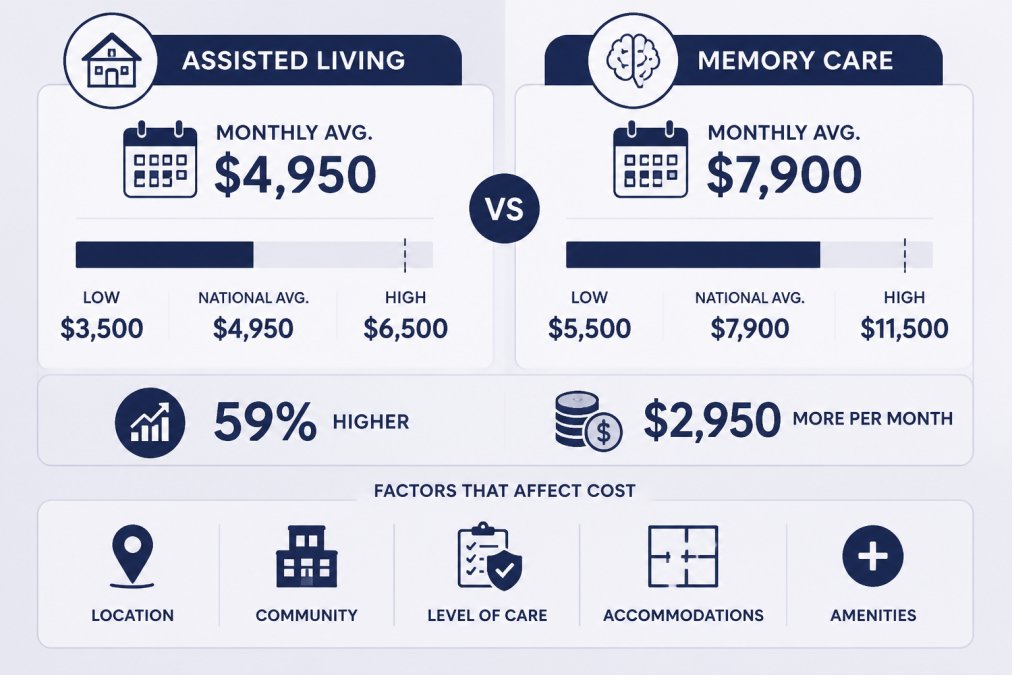
National Average Monthly Costs at a Glance
Assisted living is a residential senior living community that provides help with activities of daily living (ADLs) such as bathing, dressing, and medication management, typically in a private or semi-private room setting. Memory care is a specialized form of assisted living designed specifically for individuals with Alzheimer's disease or other forms of cognitive impairment, featuring secured environments, higher staff-to-resident ratios, and structured dementia programming.
According to the Genworth Cost of Care Survey, national median monthly costs for assisted living hover around $5,000, while memory care communities typically run $2,000 to $3,000 more per month. These figures vary considerably by region, room type, and the specific services bundled into the base rate.
| Care Type | Estimated Monthly Range | Key Differentiator |
|---|---|---|
| Assisted Living | $3,500 - $6,500 | Help with ADLs, community amenities |
| Memory Care | $5,500 - $9,000 | Secured environment, dementia programming |
| Nursing Home (semi-private) | $8,000 - $10,000+ | 24/7 skilled nursing care |
| Respite Care (per day) | $150 - $300 | Short-term, temporary relief |
How Regional Cost-of-Living Affects Your Bill
Geography is one of the single biggest drivers of long-term care costs. States in the Northeast and Pacific Coast tend to carry the highest senior living costs, while the South and Midwest often offer more affordable options for comparable care.
The A Place for Mom Cost Calculator allows families to enter a specific zip code and compare local senior living costs against national benchmarks. A memory care suite in a high cost-of-living metro can easily run double what a comparable suite costs in a mid-sized Southern city.
Levels of Care in Senior Living: What Each Option Covers
The price difference between memory care and assisted living reflects a genuine difference in what each level of care provides.
What Assisted Living Provides Day to Day
Assisted living communities support seniors who need help with ADLs but do not require around-the-clock skilled nursing. A typical assisted living community offers assistance with bathing, dressing, grooming, and toileting; medication management and reminders; chef-prepared meals; housekeeping and laundry services; social activities and fitness programs; transportation to medical appointments; and 24/7 staff availability.
The defining feature of assisted living is that residents retain meaningful independence. Staff support is there when needed, but residents can move freely, socialize on their own schedule, and make daily decisions for themselves.
What Specialized Memory Care Adds
Memory care goes several steps further. A specialized memory care community is built around the specific needs of individuals with Alzheimer's disease and other forms of cognitive impairment. Key additions over standard assisted living include secured perimeters and wandering prevention systems; higher staff-to-resident ratios with dementia-specific training; structured daily routines designed to reduce anxiety and behavioral episodes; therapeutic activities targeting cognitive engagement; dedicated caregiver support resources; safety protocols for medication management and fall prevention; and environments designed to minimize sensory overstimulation.
A senior with mild cognitive impairment may thrive in assisted living for years. A senior with moderate-to-advanced Alzheimer's disease needs the safety infrastructure and specialized programming that only a dedicated memory care community provides.
Why Memory Care Costs More Than Assisted Living
Memory care costs more than assisted living for three concrete, structural reasons: staffing, safety infrastructure, and programming.

Staffing Ratios and Specialized Training
Memory care communities maintain staff-to-resident ratios of one caregiver to five or six residents during daytime hours, compared to ratios of one to eight or higher in assisted living. Overnight staffing is also stronger in memory care because behavioral episodes, nighttime wandering, and fall risk require active monitoring.
Memory care staff require specialized training in dementia care techniques, including de-escalation strategies, communication approaches tailored to cognitive impairment, and engagement through remaining abilities. This expertise carries a real labor cost.
Safety Infrastructure and Wandering Prevention
Wandering is one of the most serious safety risks for individuals with Alzheimer's disease. Memory care communities invest in secured environments that prevent residents from leaving unsafely, including keypad entries, enclosed outdoor courtyards, and door-alert systems. These physical modifications are expensive to build and maintain, and require more active staff monitoring.
Therapeutic Activities and Dementia Programming
Evidence-based dementia programming, like the I'm Still Here® philosophy practiced at Emory Mills in partnership with the Hearthstone Institute, focuses on meaningful engagement tailored to each resident's life story and remaining cognitive strengths. This kind of programming requires trained activity staff, individualized care planning, and dedicated space.
Hidden and Transition Costs Families Often Overlook
The monthly rate is only part of the picture. Many families are blindsided by costs that appear before, during, and after the initial move.
Community fees typically range from one to several months' worth of the base rate and are rarely refundable. Care level reassessments may trigger higher monthly charges as cognitive impairment progresses. Medication management fees, incontinence supplies, and cognitive assessment and care planning fees are frequently excluded from base rates and billed separately. Moving costs, storage, and home modifications also add up quickly.
A resource like Caring.com's senior living cost guide offers a useful breakdown of which fees are standard and which to specifically ask about during community tours.
Does Medicare Pay for Assisted Living or Memory Care?
What Medicare Actually Covers
Medicare does not pay for assisted living or memory care. Medicare is health insurance, not long-term care insurance. It covers medically necessary services including hospital stays, skilled nursing facility care following a qualifying hospital stay, and some home health services, but not the room, board, or personal care services that define assisted living and memory care.
Medicare may cover specific medical services a resident receives while living in a community, such as physician visits or physical therapy, but those are billed separately and do not reduce the monthly community fee.
Medicaid and State Waiver Programs
Medicaid is the primary public payer for long-term care for individuals who meet income and asset eligibility requirements. Medicaid can cover assisted living and memory care costs through Home and Community-Based Services (HCBS) waiver programs, which vary significantly by state.
The Medicaid.gov HCBS waivers overview provides state-by-state information on which waiver programs are available and what they cover. Medicaid planning is complex and time-sensitive. Families should consult with an elder law attorney before transferring assets or making financial decisions that could affect eligibility.
Financial Assistance for Memory Care: Your Options
Long-Term Care Insurance
Long-term care insurance is designed specifically to cover services like assisted living and memory care. Policies purchased before a diagnosis can cover a significant portion of monthly costs, depending on the benefit amount, elimination period, and inflation protection.
The catch: policies must be purchased while the individual is still healthy and insurable. A diagnosis of Alzheimer's disease typically disqualifies an applicant.
Veterans Benefits and Tax Deductions
Veterans and surviving spouses may qualify for the VA Aid and Attendance benefit, which provides monthly payments to help cover the cost of assisted living or memory care. Eligibility is based on military service, medical need, and financial criteria.
Medical expenses including qualified long-term care services may be deductible if they exceed a threshold percentage of adjusted gross income. Families should work with a tax professional to determine what is deductible in their specific situation.
Out-of-Pocket Planning and Bridge Strategies
Many families fund senior living primarily out of pocket, using a combination of home sale proceeds, retirement savings, Social Security income, life insurance conversions, and bridge loans designed specifically for senior living transitions.
The most important thing families can do is start financial planning before a crisis. Reactive planning made under emotional pressure consistently produces worse outcomes than proactive planning.
How to Choose Between Memory Care and Assisted Living
The right choice between memory care and assisted living is not primarily a financial decision. It is a clinical one that has financial consequences.
A senior with early-stage cognitive impairment, intact safety awareness, and the ability to manage basic ADLs with prompting may be well-served in assisted living for months or years. A senior with moderate-to-advanced Alzheimer's disease, wandering behavior, or significant behavioral episodes needs the secured environment and specialized dementia care that only a dedicated memory care community provides.
| Factor | Choose Assisted Living | Choose Memory Care |
|---|---|---|
| Cognitive status | Mild impairment, intact judgment | Moderate to advanced dementia |
| Safety awareness | Can recognize and respond to hazards | Wandering risk, poor hazard recognition |
| Behavioral episodes | Rare or absent | Frequent or unpredictable |
| ADL support needed | Prompting and occasional help | Consistent hands-on assistance |
| Social engagement | Can initiate and navigate social settings | Needs structured, supervised programming |
| Family caregiver capacity | Family can supplement care safely | Family needs full professional support |
When in doubt, err toward the level of care that matches the current clinical picture. Families often delay memory care placement out of guilt or cost concerns, only to face a crisis that forces a rushed transition.
Visiting communities in person, asking specific questions about staffing ratios, and understanding the care philosophy are all essential steps. At Emory Mills, the I'm Still Here® philosophy means care is built around each resident's remaining abilities and personal life story, not a standardized protocol.
Choosing between memory care vs assisted living costs requires honest assessment of both clinical need and long-term financial capacity. Emory Mills offers 33 assisted living suites and 13 specialized memory care suites, with 24/7 support, chef-prepared meals, and evidence-based dementia programming through the I'm Still Here® philosophy. Families facing this decision deserve a community that treats their loved one as a whole person, not a diagnosis. Schedule a tour at Emory Mills to see the difference firsthand.
Frequently Asked Questions
Is memory care more expensive than assisted living?
Yes, memory care consistently costs more than standard assisted living. The gap reflects higher staff-to-resident ratios, specialized dementia training, secured environments designed to prevent wandering, and structured therapeutic programming. The Genworth Cost of Care Survey shows memory care monthly median costs running meaningfully higher than assisted living nationally, though exact figures vary by state and community. Contact individual communities directly for current pricing in your area.
Does Medicare cover memory care or assisted living costs?
Medicare does not cover ongoing room and board in assisted living or memory care communities. It may pay for short-term skilled nursing care following a qualifying hospital stay, or for specific medical services like physician visits and prescription drugs. Medicaid can cover some long-term care costs for eligible individuals, often through state Home and Community-Based Services waivers. Check Medicare.gov and your state Medicaid office for current eligibility rules and covered services.
When should someone move from assisted living to memory care?
The transition from assisted living to memory care is worth considering when cognitive impairment begins affecting safety. Signs include repeated wandering or exit-seeking, inability to manage activities of daily living even with staff prompting, significant behavioral episodes, or a diagnosis of moderate-to-advanced Alzheimer's disease. A geriatric care manager or the resident's physician can conduct a formal level-of-care assessment to guide the decision. Early planning avoids crisis-driven moves.
What financial assistance is available for memory care?
Families funding memory care can draw on several sources beyond personal savings. Long-term care insurance policies often cover memory care if the policy was purchased before diagnosis. Veterans and surviving spouses may qualify for VA Aid and Attendance benefits. Medicaid Home and Community-Based Services waivers provide subsidized care for income-eligible seniors in many states. Some families also use bridge loans against home equity while awaiting benefit approvals. A certified elder law attorney can help structure payments for potential tax deductions.
What hidden costs should families watch for when transitioning to memory care?
Beyond the base monthly rate, families often encounter one-time community fees, level-of-care reassessment charges as needs increase, medication management fees, incontinence supply costs, and transportation charges. Moving and room-furnishing expenses add up quickly. Some communities bill separately for specialized therapies or higher-acuity behavioral support. Asking for a complete, itemized fee schedule before signing any agreement helps avoid surprises after the transition.
This article was written using GrandRanker