 how-to
How to Talk to Parents About Assisted Living
Table of Contents
- Start the Assisted Living Talk Before a Crisis Forces It
- Signs It Is Time for Assisted Living
- Choose the Right Time, Setting, and People
- Scripts for Talking to Parents About Senior Care
- How to Handle Resistance to Assisted Living
- Get Legal and Financial Documents in Order First
- Honor Your Parent's Dignity and Autonomy Throughout
- Conclusion
Last Updated: August 12, 2026
Start the Assisted Living Talk Before a Crisis Forces It
Knowing how to talk to parents about assisted living is one of the hardest conversations adult children ever face. At Emory Mills, we work with families every day who waited until a fall, hospital stay, or missed medication forced the issue. By then, the conversation happens under pressure, with fewer options and higher emotional stakes.
The most important thing you can do is start early, before any crisis. Starting the conversation early gives your parent time to process, ask questions, and feel like a participant rather than someone being managed. It also gives your family time to research communities, understand costs, and get legal documents in order.
Treat this as an ongoing series of conversations, not a single event. Bring it up casually when you see a relevant news story or during a regular visit. This reduces the emotional charge and normalizes planning as something thoughtful families do.
According to the National Institute on Aging's guidance on long-term care planning, planning for care transitions well before they become necessary leads to better outcomes for both seniors and their families.
Signs It Is Time for Assisted Living
Recognizing when the need for assisted living is genuine rather than precautionary is not always straightforward. The clearest signal is a pattern of safety concerns or health decline that caregiving at home can no longer reliably address.
Physical Safety Red Flags
Physical safety red flags are the most common reason families research assisted living. These include frequent falls, difficulty managing bathing or dressing, unexplained weight loss, missed medications, driving incidents, and homes that have become unsafe or difficult to maintain. A cluster of these, or a pattern that worsens over weeks, signals that home care support is insufficient.
Cognitive and Emotional Warning Signs
Cognitive and emotional warning signs develop gradually. Watch for increasing confusion about dates or people, repeated questions, withdrawal from previously enjoyed activities, signs of depression or irritability, getting lost in familiar places, and declining personal hygiene. Social isolation is particularly dangerous, it accelerates cognitive decline and increases depression risk. A supportive environment with regular social engagement can meaningfully slow that trajectory.
Choose the Right Time, Setting, and People
The setting and timing of this conversation matter more than most families realize. Choose a quiet time when your parent is rested, in a familiar private setting like their home or yours. Sit at eye level and turn off distractions. Make it feel like a conversation, not an intervention.
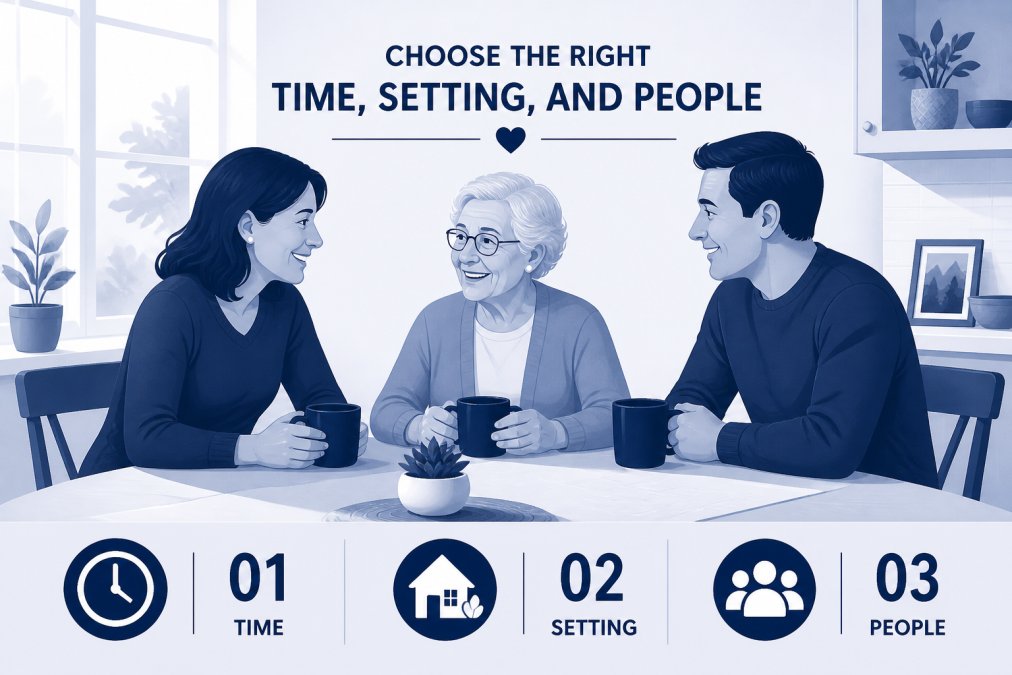
Think carefully about who should be present. Including a sibling or trusted family member can reinforce shared concern, but too many people can feel overwhelming. Two or three family members is usually right. If family dynamics are contentious, start one-on-one first.
Follow these practical rules: give your parent a heads-up before the conversation, allow enough time so it does not feel rushed, and bring a notepad to signal you are taking their preferences seriously.
Scripts for Talking to Parents About Senior Care
Scripts do not need to be elaborate. Simple, honest language works better than carefully rehearsed arguments.
Opening Lines That Lower Defenses
The biggest mistake is leading with the problem. "Mom, you can't keep living alone" immediately puts a parent on the defensive. Lead with care and curiosity instead:
- "I've been thinking about what the future looks like for our family, and I want to make sure we're planning together, not scrambling later. Can we talk about that?"
- "I know this isn't easy, and I'm not trying to push anything. I just want to understand what feels important to you about where you live and how you're cared for."
- "I've been reading about some communities that are really different from what I expected. Would you be open to just taking a look together, no commitment?"
The phrase "no commitment" does significant work. A tour is not a move-in date. Framing exploration as low-stakes reduces resistance.
What to Say When They Ask About Cost
Cost is almost always part of this conversation. Be honest about what you know and what you are still learning: "I don't have exact numbers yet, but I'm working on understanding what's included, what Medicare or Medicaid might cover, and what we'd be paying out of pocket. I want us to look at this together so there are no surprises."
The Medicare and Medicaid overview from the Centers for Medicare and Medicaid Services is a reliable starting point for understanding what federal programs cover. For current pricing at any specific community, always ask directly and request a written breakdown of what is included versus billed separately.
How to Handle Resistance to Assisted Living
Resistance is not failure. It is the normal, expected response to a major life change. The goal is not to overcome resistance in a single conversation, but to keep the conversation open.
Most resistance comes from fear: fear of losing independence, fear of the unknown, or fear of becoming a burden. Addressing the fear directly, rather than arguing against the stated objection, tends to be far more effective. If your parent says "I'm not ready," ask: "What would need to be different for you to feel ready?" That question shifts the conversation from a standoff to planning.
When a Parent with Dementia Refuses to Move
When a parent with dementia refuses to move, logical arguments rarely work because cognitive decline affects the ability to weigh long-term risk. What tends to work better: focus on immediate, concrete benefits ("There will be someone there to help you at night if you need it"), involve their physician (a doctor's recommendation carries authority family members often cannot), use short, calm visits to familiar-feeling communities, and consider consulting a geriatric care manager who specializes in care transitions.
The Alzheimer's Association guidance on care decisions offers detailed, practical advice for families navigating memory care transitions with a resistant parent.
When to Bring In a Professional Mediator
A professional mediator is worth considering when family disagreement is blocking progress. Siblings often have fundamentally different assessments of a parent's needs and different levels of caregiving involvement. A geriatric care manager or certified elder mediator can facilitate a structured conversation that keeps focus on the parent's wellbeing rather than family dynamics. This is a practical tool that protects the parent from being caught in the middle of family conflict.
Get Legal and Financial Documents in Order First
Legal and financial documentation readiness is the part of this process that most families handle too late. Before any care transition happens, certain documents need to be in place.
| Document | What It Does | Why It Matters Before a Move |
|---|---|---|
| Durable Power of Attorney | Authorizes a trusted person to manage finances | Required if a parent becomes incapacitated |
| Healthcare Proxy / Medical POA | Designates a healthcare decision-maker | Needed if parent cannot communicate wishes |
| Advance Directive / Living Will | Documents medical treatment preferences | Guides care providers on end-of-life decisions |
| POLST Form | Physician-signed medical orders for care | Travels with patient across care settings |
| Long-Term Care Insurance Policy | May cover assisted living costs | Must be activated before benefits are available |
If these documents do not exist, an elder law attorney can help establish them. Many families discover they need these documents only after a parent has lost legal capacity to sign them, which creates a far more complicated situation.
The National Academy of Elder Law Attorneys directory can help families find qualified elder law attorneys in their area.
Honor Your Parent's Dignity and Autonomy Throughout
The single most important thing families can do throughout this process is treat their parent as the primary decision-maker for as long as that is safely possible. Ask for their preferences, not just their consent. Present options rather than conclusions. Listen to what they value most, privacy, staying near family, keeping a pet, or maintaining a routine, and find a community that honors those things.

Dignity is not just about tone. It is about process. A parent who feels heard and involved in the decision is far more likely to make a successful care transition than one who feels managed or overruled.
At Emory Mills, the approach to assisted living and memory care is built around this principle. The community's evidence-based I'm Still Here® philosophy, developed in partnership with the Hearthstone Institute, focuses on each resident's remaining abilities and personal life story rather than what they can no longer do.
Knowing how to talk to parents about assisted living does not get easier with time, but it does get more manageable with the right preparation. The families who navigate this well start early, listen more than they speak, get their legal and financial documents in order before they are needed, and choose a community that genuinely honors their parent's individuality. Emory Mills offers 33 assisted living suites and 13 specialized memory care suites, with 24/7 support, chef-prepared meals, and a care philosophy grounded in each resident's unique life story. Schedule a tour with Emory Mills and see what a truly person-centered community looks like in practice.
Frequently Asked Questions
What is the 40-70 rule for talking to aging parents?
The 40-70 rule is a guideline suggesting that adult children around age 40 should begin having conversations with parents around age 70 about future care preferences, finances, and living arrangements. Starting early, before a health decline forces the issue, gives everyone time to make thoughtful decisions rather than reactive ones. It reduces conflict, preserves your parent's autonomy, and allows proper legal and financial planning to happen without pressure.
How do you introduce the idea of assisted living without causing conflict?
Frame the conversation around your parent's goals, not your concerns. Instead of listing problems, ask what matters most to them: staying active, feeling safe, keeping friendships. Then connect assisted living to those goals. Avoid ultimatums, choose a calm private setting, and spread the conversation across multiple visits. Bringing in a trusted family member or geriatric care manager can also reduce the feeling that one person is pushing an agenda.
What should I do if my parent with dementia refuses assisted living?
Refusal is common and rarely changes with direct argument. Instead, focus on the specific fear driving the refusal, whether that is losing independence, leaving home, or being forgotten. Validate those fears before responding. Short visits to a memory care community can reduce anxiety more than any conversation. If refusal creates genuine safety concerns, consult the primary care physician, an elder law attorney, or a geriatric care manager about next steps, including whether a care plan or legal intervention is appropriate.
What are the signs that it is time for assisted living?
Common signs include frequent falls or near-misses, missed medications, unexplained weight loss, unpaid bills, social isolation, caregiver burnout in the family, and difficulty managing daily tasks like bathing, cooking, or dressing. Cognitive changes such as confusion, memory lapses, or wandering are also serious indicators. No single sign is definitive, but when several appear together or safety is at risk, a conversation with the primary care physician and a tour of local communities is a reasonable next step.
This article was written using GrandRanker